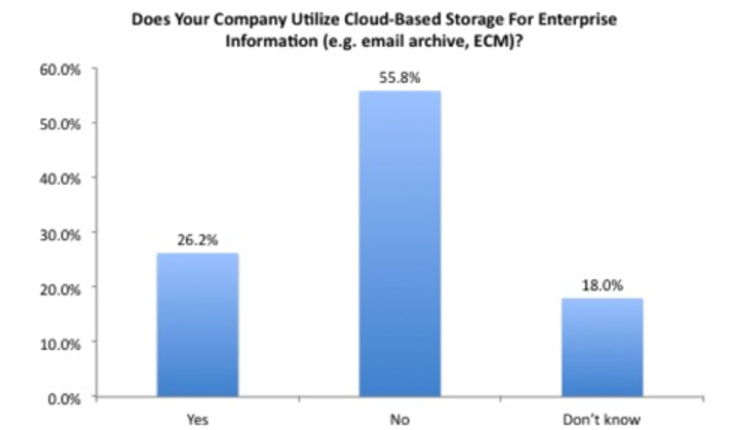
The cloud can drastically reduce the costs of storing information and implementing applications and is, therefore, a hot topic. However, it is also a controversial one. The cloud, as a term, is used as... View More
Last week, Google announced Google Drive as a solution to store, share and synchronize content across multiple devices. Big deal? Yes, this could be a very big deal. Why? Here's the deal: Up until now,... View More
Editor\'s Note: Missed the first installment of the article? Click here for Part I. Major risks of cloud computing So what are the risks involved in cloud computing? These risks fall under four categories:... View More
What is a \"Cloud?\" By way of defining the modern concept of cloud computing, it is useful to note that in computer parlance, \"cloud\" is a synonym for \"domain.\" Indeed, it is both relevant and enlightening... View More
Digital rights management (DRM) is a child of the Digital Millennium Copyright Act (DMCA), passed by the US Congress in 1998 to heighten the penalties for copyright infringement on the Internet. It amends... View More
Toshiba America Business Solutions Inc. (TABS) proudly announced the availability of Fasoo.com Digital Rights Management (DRM) solutions to its direct and independent dealers and their customers. Fasoo.com... View More
RFID, a technology first invented by the USSR for US surveillance at the beginning of the Cold War, is fast becoming the new technology of the late 2000s. RFID, otherwise known as "the Internet of things,"... View More
The form is the thing. In fact, it lies at the heart of all document-centric applications. Yet, as science marches on and technology convergence runs its inevitable course, it becomes easier and easier... View More
The Importance of Integrity and Flexibility Imagine the scenario where the CIO reviews the long-term goals of the IT organization and outlines an initiative to develop business intelligence (BI) architecture... View More
Once the right price points are achieved, the scope of RFID applications is limited solely by the ingenuity and imagination of the user. Aside from supply chain management, here are some of the most popular... View More
Recent headlines lead businesses and consumers to believe that the majority of data breaches occur online. According to "Security of Paper Documents in the Workplace," a new study from the Ponemon Institute,... View More
Pick up an article in information technology, records management or electronic discovery trade press, and you will see that information is moving to the "cloud." What is the cloud? Perhaps the simplest... View More
Even if you are not a programmer, you have likely heard some mention of XML within your organization and throughout the industry. Certainly, your technologists are using it when explaining how they are... View More
Today, financial institutions can realize continued growth in one of the most mature of treasury management services — wholesale lockbox (WLBX) — even as B2B check payments inexorably relinquish... View More
Perhaps the most document-specific rule of evidence concerns the often misunderstood best evidence rule, which derives from 18th century English common law. The rule states that to prove the contents of... View More
Change is scary. And not just a little — it's really, really scary. What else (besides money) explains why entrenched technologies continue on way past their time? Let's face it, "If it ain't broke... View More
Making Every Customer Message MatterIn financial services, communication is often treated as a necessary obligation. A policy document must be delivered, an account statement must be sent, a claim let
Enterprise communications have long been framed as a debate between physical and digital delivery. Organizations pursuing cost savings often viewed digital transformation as a pathway to reducing or e
As an avid movie goer, I regularly visit my local cinema for the latest release, blockbusters, or smaller independent films. Recently it occurred to me that my ticket purchase behavior had narrowed to
Every year, somewhere in your organization, a contract comes up for renewal. Your team prepares. They benchmark pricing, sketch out alternatives on paper and walk into the negotiation expecting a reas