Image by: Ievgeniiya Ocheretna, ©2018 Getty Images
Robotic process automation (RPA) software is an important and evolving technology category that organizations should consider as part of an overall process transformation initiative. At IDC, we define RPA as software that is designed to automate or augment manual, repetitive tasks. Those tasks may be executed by a knowledge worker outside the context of a business process or may replace a manual task within an enterprise application or a custom business process.
Some RPA vendors extend this definition to include other elements of automation, such as artificial intelligence (AI), machine/deep learning, decision automation and optimization, as well as other technologies more closely aligned with workflow and case management.
Many vendors in this space position RPA as a technology to offload repetitive, mundane tasks, increase worker productivity as well as job satisfaction, and to focus humans on higher value work. Clearly, effective change management is a crucial best practice for RPA deployment.
The value proposition for task automation in general, and with RPA specifically, is quite compelling, driving double-digit (and sometimes triple-digit) growth in this market. Over the next five years, we estimate that 54% of current enterprise spending on non-cloud custom and packaged applications will focus on RPA (especially those that would benefit from task automation). Non-cloud enterprise applications are a key target for RPA, because they tend to have insufficient APIs, are based on older technology, or are non-standardized.
As organizations embark on their inevitable transition to a digital workforce, technology suppliers must understand if and how their solutions play in the task automation ecosystem. RPA will not be the only choice for task automation but rather just one tool within the overall process automation portfolio.
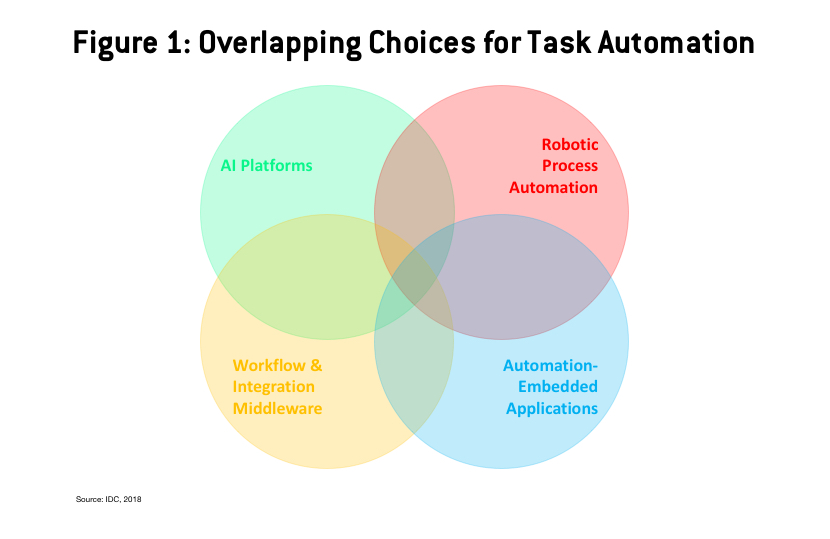
The above figure shows the overlapping nature of software used to automate tasks, including RPA, AI platforms, middleware used for custom integration and automation, and a next generation of automation-focused applications offered by application vendors.
Due to the overlapping nature of this market, AI platform vendors, such as Google, IBM, and Microsoft, are forming partnerships with RPA vendors as well as developing their own AI-enabled process automation capabilities. IDC expects that these efforts and partnerships will accelerate throughout the remainder of 2018 and into 2019 in order to organically develop the capabilities needed to expand their mandates.
Holly Muscolino is the Research Vice President of the Content Technologies and Document Workflow group at IDC and is responsible for research related to enterprise content management, including records management and case management. Follow Holly on Twitter @hmuscolino.





![IDC graphics for Document Strategy[2]](https://cms-static.wehaacdn.com/documentmedia-com/images/IDC-graphics-for-Document-Strategy-2-.2474.widea.0.jpg)