Digital Process Automation: Why You Will Need Low-Code, RPA, and Content Services in 2020 |
| By Connie Moore |
|
|
 Image by: shark_749, ©2019 Getty Images As the calendar winds down for the year, everyone’s focus is turning to what 2020 will bring. There's one thing that’s definite though—digital transformation will remain on virtually every organization’s roadmap, no matter their size or business goal. However, transformation isn’t easy. Organizations soon learn that outdated processes, inaccessible data and content, aging technology, and entrenched behaviors are big boulders on the path to foundational change. Given this reality, digital process automation has become a key building block for digital transformation, allowing executives to reshape, remold, and supercharge the organization’s outdated business processes—without lengthy and costly efforts to revamp existing applications. Whether you're streamlining the business operations, revitalizing customer experience, or implementing end-to-end business processes, there are two key capabilities in 2020 that will be significant differentiators. By combining low-code process platforms alongside robotic process automation (RPA), organizations can quickly deploy new business process solutions.
In addition, content services will also remain a key mainstay for business process transformation. If process automation were the equivalent of a factory, then content would be the fuel for that factory’s engine. Years ago, workflow surfaced as a feature or component of document management systems. Eventually, two kinds of vendors emerged:
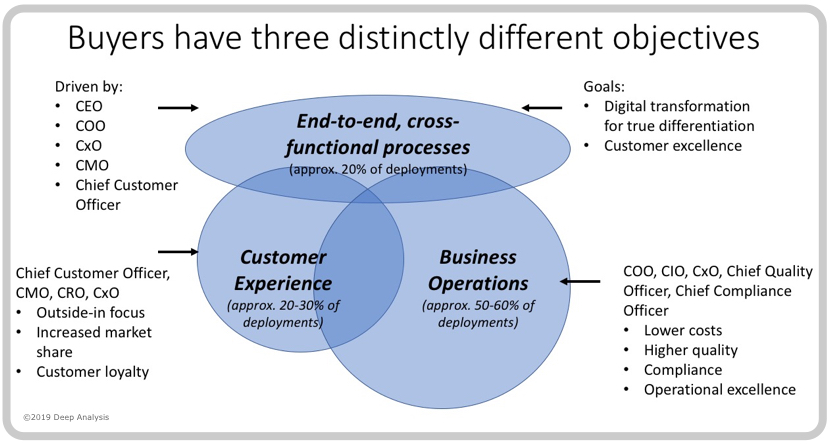 In 2020, the nexus of low-code automation, RPA, and content services will power process-centric digital transformation in three main areas: 1. Business OperationsThe back office has the most informed executives, greatest penetration, and deepest skill sets in process automation. Many operations are still mired in outdated processes, relying on siloed data and content repositories and using a plethora of costly, manual steps. To overcome this morass, executives are embracing digital process automation to provide greater productivity, efficiency, and cost savings. 2. Customer ExperienceIncreasingly, businesses are upending inside-out ways of thinking, replacing it with more compelling, customer-friendly outside-in approaches. Executives within sales, marketing, and customer service are listening to the voice of the customer, doubling down on customer journey maps, and identifying touchpoints and moments of truth within newly automated business processes. 3. End-to-End, Cross-Functional ProcessesThese ambitious projects automate manual and semi-manual tasks, work across content and data silos, orchestrate business applications, and tackle customer-facing activities. The focus is on next-generation portals, web content, e-commerce, omni-channel, and natural language processing. Business champions for these initiatives are typically in the C-suite. Process automation gives organizations faster, easier approaches for improving and automating their business processes, while also replacing mundane, repetitive, and often clerical tasks with bots. By realizing a vision that includes low-code, RPA, and content services, organizations will speed process automation, reduce operational costs, and transform customer engagement without requiring massive investments and technology overhauls. The bottom line? Put process automation on your roadmap for 2020. Connie Moore is the Vice President and Principal Analyst at Deep Analysis, a research advisory firm focused on emerging technologies. Her research spans many facets of content and process management, from customer experience to business automation. Contact her at www.deep-analysis.net or follow her on Twitter at @cmooreclarity.
|
